.
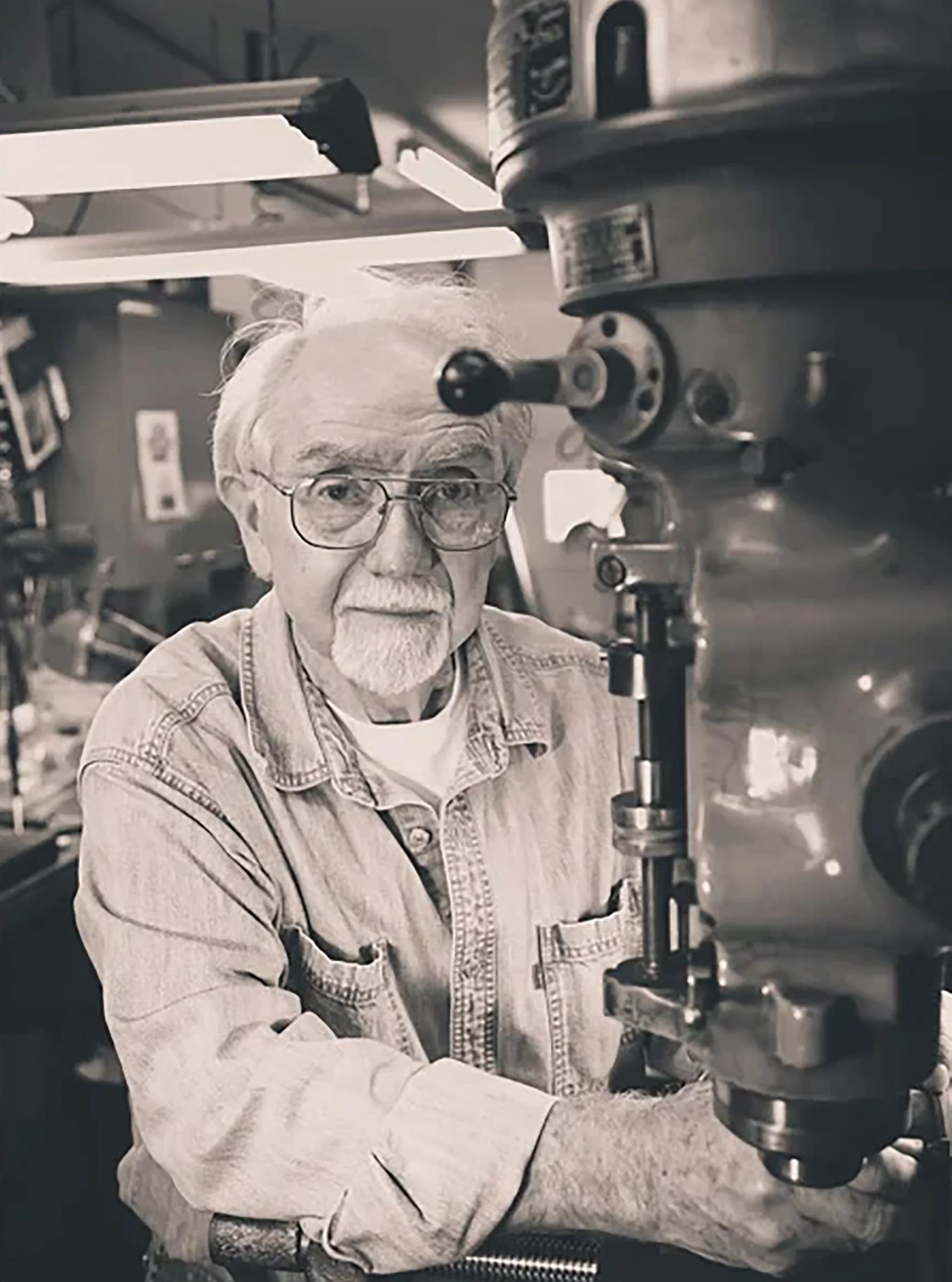
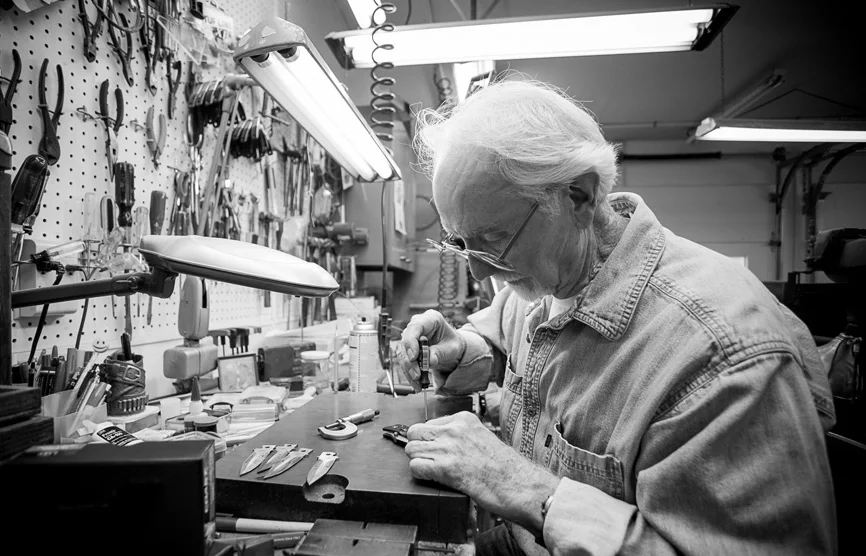
Ron Lake is widely regarded as one of the most influential figures in modern custom knifemaking. Often referred to as the “father of the modern folding knife,” he has been designing and producing knives for over five decades.
His career began in 1960 after earning a degree in machine tooling. He worked as a model and pattern maker for an electrical manufacturing company, contributing to projects including naval sonar equipment, and later spent ten years producing prototypes for the aviation and automotive industries. This foundation in precision machining and engineering would become central to his approach to knifemaking.
In 1965, Lake began making knives in a small garage workshop, initially as a hobby. His early work focused on fixed-blade hunting knives, but by 1970 he introduced a design that would fundamentally shift the field: the first Tail-Lock “Interframe” folding knife. This innovation utilized a machined metal frame to house and protect the handle material, increasing structural integrity while allowing for tighter tolerances and refined construction. The placement of the locking tab at the end of the knife provided improved mechanical leverage and a distinct, controlled action.
These design elements marked a turning point in folding knife construction and continue to influence makers today. Lake did not simply refine existing forms. He changed how folding knives are built.
Before makers like Lake, knives were primarily understood as tools. His work helped define the “art knife,” establishing the folding knife as an object of fine craft. His designs remain technically and aesthetically definitive decades later, having set the standard for form, function, and craftsmanship.
Lake joined the Knifemakers’ Guild in 1971 and became a full-time maker the following year. His signature Interframe design was patented in 1974. In 1998, he was inducted into the Cutlery Hall of Fame.
His knives are known for flawless fit and finish, seamless transitions between materials, and a minimal, highly resolved geometry. Each piece reflects a deep understanding of material, balance, and restraint. His work bridges the disciplines of machining, engineering, and fine craft, establishing a standard of precision that continues to define the field.
The Interframe folder remains one of the most enduring and recognizable forms in contemporary knifemaking. Owning one is often understood not simply as acquiring an exceptional object, but as holding a foundational work within the history of the medium.
Lake’s knives are held in major collections including the Smithsonian Institution and the Metal Museum in Memphis, Tennessee. In addition to his handmade knives, he has developed designs for companies such as Coast Cutlery, CRKT, and Schrade, contributed to publications on knifemaking, and continues to share knowledge with emerging makers.